


The main goal of tidypredict is to enable running
predictions inside databases. It reads the model, extracts the
components needed to calculate the prediction, and then creates an R
formula that can be translated into SQL. In other words, it is able to
parse a model such as this one:
model <- lm(mpg ~ wt + cyl, data = mtcars)tidypredict can return a SQL statement that is ready to
run inside the database. Because it uses dplyr’s database
interface, it works with several databases back-ends, such as MS
SQL:
tidypredict_sql(model, dbplyr::simulate_mssql())## <SQL> (39.686261480253 + ([wt] * -3.19097213898374)) + ([cyl] * -1.5077949682598)Install tidypredict from CRAN using:
install.packages("tidypredict")Or install the development version using
devtools as follows:
install.packages("remotes")
remotes::install_github("tidymodels/tidypredict")tidypredict has only a few functions, and it is not
expected that number to grow much. The main focus at this time is to add
more models to support.
| Function | Description |
|---|---|
tidypredict_fit() |
Returns an R formula that calculates the prediction |
tidypredict_sql() |
Returns a SQL query based on the formula from
tidypredict_fit() |
tidypredict_to_column() |
Adds a new column using the formula from
tidypredict_fit() |
tidypredict_test() |
Tests tidypredict predictions against the model’s
native predict() function |
tidypredict_interval() |
Same as tidypredict_fit() but for intervals (only works
with lm and glm) |
tidypredict_sql_interval() |
Same as tidypredict_sql() but for intervals (only works
with lm and glm) |
parse_model() |
Creates a list spec based on the R model |
as_parsed_model() |
Prepares an object to be recognized as a parsed model |
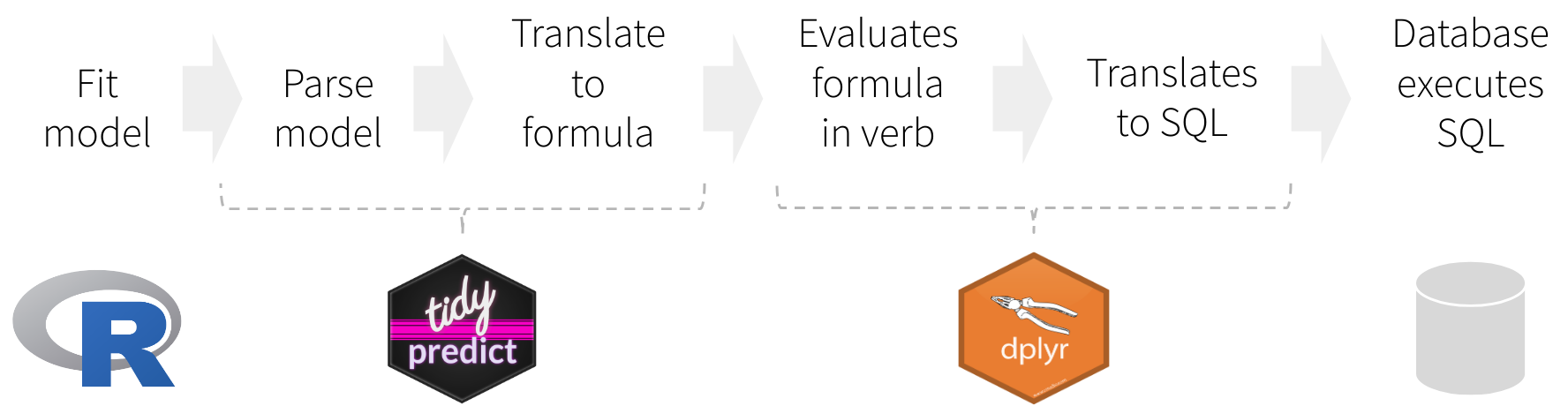
Instead of translating directly to a SQL statement,
tidypredict creates an R formula. That formula can then be
used inside dplyr. The overall workflow would be as
illustrated in the image above, and described here:
tidypredict reads model, and creates a list object with
the necessary components to run predictionstidypredict builds an R formula based on the list
objectdplyr evaluates the formula created by
tidypredictdplyr translates the formula into a SQL statement, or
any other interfaces.dplyrtidypredict writes and reads a spec based on a model.
Instead of simply writing the R formula directly, splitting the spec
from the formula adds the following capabilities:
.rds - Specifically for cases
when the model needs to be used for predictions in a Shiny app.tidypredict. It also means, that the
parsed model spec can become a good alternative to using
PMML.tidypredict parses 43 fitted model classes from 30
modeling packages. Supported
models has the full list, with the parsnip spec and
engine for each and a link to a worked example. In brief:
lm(), glm(),
glmnet::glmnet(), LiblineaR::LiblineaR(),
quantreg::rq(), nnet::multinom(),
kernlab::ksvm(), nnet::nnet(),
earth::earth(), mixOmics PLS,
parsnip::nullmodel()naivebayes::naive_bayes(), klaR::NaiveBayes(),
MASS::lda(), MASS::qda(),
mda::fda(), sda::sda(),
sparsediscrimrpart::rpart(),
C50::C5.0(), partykit::ctree() and
cforest(), randomForest::randomForest(),
ranger::ranger(), aorsf::orsf(),
baguette::bagger(), dbarts::bart()xgboost, lightgbm,
catboost, mboost::blackboost(),
Cubist::cubist(), xrf::xrf(), H2O GBM and
RuleFittidypredict dispatches on the class of the fitted model,
so models fitted through parsnip work for any engine whose
underlying model appears above: pass the parsnip fit object
to tidypredict_fit() just as you would the engine’s own
fit.
tidypredict_interval() and
tidypredict_sql_interval() are narrower, and only support
lm() and glm() models.
broomThe tidy() function from broom works with linear models
parsed via tidypredict
pm <- parse_model(lm(wt ~ ., mtcars))
tidy(pm)
## # A tibble: 11 × 2
## term estimate
## <chr> <dbl>
## 1 (Intercept) -0.231
## 2 mpg -0.0417
## 3 cyl -0.0573
## 4 disp 0.00669
## 5 hp -0.00323
## 6 drat -0.0901
## 7 qsec 0.200
## 8 vs -0.0664
## 9 am 0.0184
## 10 gear -0.0935
## 11 carb 0.249This project is released with a Contributor Code of Conduct. By contributing to this project, you agree to abide by its terms.
For questions and discussions about tidymodels packages, modeling, and machine learning, please post on Posit Community.
If you think you have encountered a bug, please submit an issue.
Either way, learn how to create and share a reprex (a minimal, reproducible example), to clearly communicate about your code.
Check out further details on contributing guidelines for tidymodels packages and how to get help.